All the recipes

No. 05Tex-MexBeef

Chilli con Carne

Toast the dried chillies and blend them into a paste. That one step is the difference between a cumin-heavy beef braise and an actual bowl of red.

John Drummond

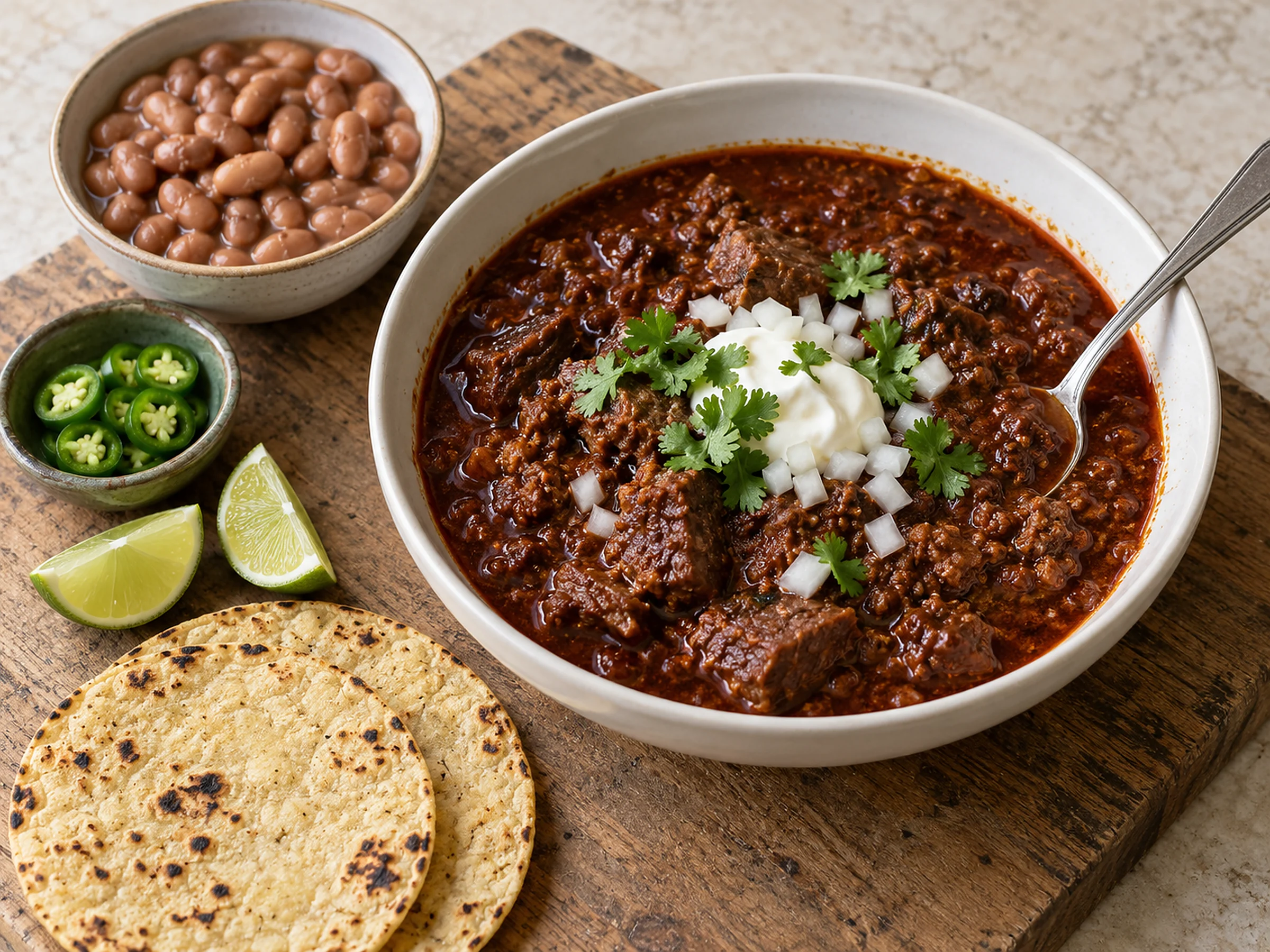
A bowl of dark red beef chilli topped with sour cream, diced white onion and coriander, with pinto beans, sliced green chilli, lime wedges and corn tortillas beside it
Prep45min
Cook3hr 15min
All up4hr
Serves10
LevelMedium

Mise en place

What you need

Tick each one off as it goes in.

For the chilli paste

For the pot

To finish

To serve

Makes 10 serves

The one thing that matters here is the chilli paste: dried chillies, toasted in a dry pan and blended into a sauce, instead of a spoon of chilli powder. Not the bourbon, not the smoke, not a secret umami ingredient. That single step is the difference between a cumin-heavy beef braise and an actual bowl of red.

Built on the Texas side of the argument — beef, chilli, cumin, oregano, no beans in the pot and no tinned tomato — using the whole-chilli handling of a Mexican chile colorado. Three deliberate deviations: tomato paste fried until it darkens, a slug of fish sauce that disappears entirely and leaves the savouriness behind, and masa harina at the end for body.

The paste has four jobs, and this one is built from what was on the shelf. Guajillo brings red-fruit brightness and clean colour. Kashmiri carries deep colour with barely any heat, so the hot chillies do not have to. The mild whole dried give bulk. Chipotles in adobo, straight from the tin, are the smoke. Heat comes from Aleppo, jalapeño powder and canned serranos.

What is missing from that line-up is ancho — the raisin-and-plum backbone — and without something in its place the pot tastes bright and smoky with a hollow middle. Six prunes, soaked alongside the chillies and blended in, cover it better than anything else in the cupboard. Sweet paprika or a jar of roasted red peppers does the same job.

Chicken stock rather than beef, which sounds backwards and is not. Supermarket beef stock contributes a muddy "beef flavouring"; clean chicken stock plus two kilos of real beef tastes more convincingly beefy than beef stock does.

The move worth stealing from the Texas competition cooks is the second dump: a reserved third of the paste, more cumin and more chilli, stirred in twenty minutes before the end. Three hours of braising flattens chilli aroma, and the late addition is what makes it smell alive in the bowl rather than merely taste strong.

On heat, because this one is meant to have some. It climbs during the braise — capsaicin is fat-soluble and three hours in beef fat pulls out far more than an early taste suggests — and it climbs again overnight. So aim a notch under during the braise and bring it up at the second dump, where you can taste and stop. Sour cream and the beans both take the edge off a bowl for anyone who wants that; water does nothing.

Things that did not earn their place, judged on whether they would survive a blind tasting: soy (redundant beside fish sauce), anchovy (the same job — do not stack both), Vegemite (the yeast bitterness is easy to pick), mushroom powder (pulls it toward mushroom-beef gravy), coffee (roast bitterness, not depth), dark beer (bitterness, and the good part boils off over three hours), bourbon (the aroma leaves, the sweetness stays). Molasses is a corrective, not an ingredient. Kaffir lime leaves were on the shelf and stayed there — citrus-floral and Southeast Asian against an earthy cumin-led braise reads as confusion rather than fusion.

Cooked once, on 6 October 2026, and corrected afterwards from what actually happened: the extra heat at the second dump was not needed, two thirds of the acid was enough, the thickener was barely wanted, the raw paste tasted alarmingly bitter before the onions and the braise sorted it out, and even a small pinch of salt at the end proved a touch too much once it cooled. Dark chocolate was tested on a split ladle and rejected. The photograph is a generated one, not a picture of that pot.
The method

Eleven moves.

  1. Meat, Salt

    Cut the chuck into slabs 35–40mm thick and do not cube it yet. Spread the salt over the chuck and the mince and refrigerate while you do everything else. Salting by weight an hour ahead seasons the meat; a pinch at the end only seasons the sauce around it.

  2. Chillies, Toast

    Stem and seed the guajillo, the Kashmiri and the mild dried. Toast each kind separately in a dry pan, pressed flat — 10 to 15 seconds a side for the big soft ones, 8 to 10 for the thinner. Stop the moment they smell fragrant and turn pliable. Black spots or acrid smoke mean burnt: throw that batch out and start it again, because burnt chilli turns the whole pot bitter and nothing later will fix it.

  3. Chillies, Soak, Blend

    A word before you taste it: the raw paste is BITTER, and that is not a mistake. Blended dried chilli is astringent until it has been braised — the braise and the 500g of onion are what turn it round, and they do.

    Deseed properly if you can be bothered; seeds and pith carry most of the harshness, and a quick job leaves enough behind to notice at this stage. Cover the toasted chillies with the just-boiled stock, add the prunes, weigh everything down and leave it 20 minutes. Bloom the gelatine in cold stock.

    Blend the soaked chillies and prunes with their liquid, the garlic, the chipotles in adobo, three serranos, the Aleppo and the jalapeño powder — a full two minutes — then pass it through a sieve. Taste the soaking liquid first: if it is genuinely acrid, discard it and blend with fresh stock.

    Set aside about a third of the finished paste for the end.

  4. Beef, Char

    Over direct coals at 300–350°C, or in a ripping-hot heavy pan, sear the slabs 75 to 90 seconds a face plus the edges — dark and a little charred outside, essentially raw in the middle. Rest 10 minutes, then cut into 30–35mm cubes.

    Slabs rather than cubes on the grill: cubes fall through the grate and overcook at the edges for not much more crust. One small chunk of hardwood is plenty, and no more — smoke barely penetrates meat that then sits submerged for two hours.

  5. Pot, Build

    Brown the mince in two thin sheets, hard, without stirring it grey, then break it into 15–20mm pieces and lift it out. Leave about 30g of fat in the pot and pour off the rest. Cook the onion 10 to 12 minutes until properly golden, not merely translucent.

    Add the tomato paste and fry it 3 to 4 minutes until it darkens to mahogany and begins to stick. Add 10g of the cumin, the coriander, 3g of the oregano, the ground allspice and plenty of black pepper, 30 seconds. Deglaze with a splash of stock and scrape up the fond.

  6. Braise

    In goes the main chilli paste, the chuck, the mince, the fish sauce, the bay and the bloomed gelatine. Add stock to come two thirds up the meat and no further — this is chilli, not soup. Bring it to a lazy simmer, never a hard boil, then lid on and into the oven at 150°C, or 140°C fan, for 1 hour 45 minutes. Stir once at the hour.

  7. Second Dump

    The chuck should yield to a spoon and still hold its corners. Skim the fat properly now — expect half a cup or more off the top, and do not stir an oil slick back in and call it richness. Stir in the reserved paste, the last 4g of cumin and 1g of oregano.

    Heat, only if it wants it: two more serranos from the tin, finely chopped and a teaspoon of Aleppo. Taste first. Cooked at full strength this needed none at all — three hours in beef fat pulls out far more capsaicin than the early tasting suggests, and it climbs again overnight.

    Cook uncovered for 20 minutes, then look at it before reaching for the thickener. Between the gelatine, a proper skim and twenty minutes uncovered it may already be there — cooked once, half the polenta went in and it probably did not need any.

    If it does, half the slurry, simmer 10 minutes, and the rest only if it still wants it. Reduce first and thicken second, and it should coat a spoon and settle slowly.

  8. Rest, Season

    Off the heat for 15 minutes, then about two thirds of the vinegar and lime, and taste before the rest — cooked once, two thirds was the whole of it. Taste it warm rather than scalding, because hot food reads under-seasoned. Vinegar and lime in 5g steps from there.

    Finished, it should be intensely beefy and chilli-led, with the acid showing up as clarity rather than sourness. Expect to add no salt at all. 2 litres of salt-reduced stock, and a gram or two from the adobo and the pickled serranos.

    5kg — near enough 1%, the top of the seasoned range, and a stew wants less than a steak does because you eat a bowl of it rather than a mouthful. Cooked once, a very small pinch at the end was still a touch too much once it had cooled.

    If your stock is not the salt-reduced sort, that line roughly doubles: drop the salt on the meat to 12g.

  9. Flat, Fix

    In this order: salt, then acid, then chilli aroma, then concentration. A long braise is far more often under-acidified than under-spiced. If it is all there but faint, reduce it uncovered. If it eats oily, skim it — lime makes oily chilli taste brighter but does not make it less oily.

    If it is bitter, 4g of molasses and ten minutes' rest, without making it sweet. And if it tastes salty once it has cooled, that is partly the temperature rather than the seasoning: as it cools the aroma drops away and the salt steps forward into the gap. Reheated and eaten hot it reads milder.

    To correct the pot, stir in 150–200ml of water or unsalted stock, warm it through, and use the thickener you held back — do not reduce it to get the body back, because that concentrates the salt you are trying to dilute.

    And served over plain unsalted rice with the beans and sour cream, a pot that is a touch salty on its own comes right in the bowl.

  10. Serve

    Beans warmed separately with a little stock, cumin and lime, and served beside rather than in: in the pot they shed starch, dilute the chilli and wreck the texture you spent four hours building. White onion, coriander, lime wedges, sour cream, warm tortillas and the rest of the serranos for anyone going the other way on heat. No cheese — it smothers the chilli aroma and turns rendered beef fat into dairy fat.

  11. No Dark Chocolate

    Everyone suggests it and it does not belong here. Tested properly rather than argued about: a ladle taken out of the finished batch, chocolate stirred into that one, the two tasted side by side. It still tasted good — and it was worse. The word for it was muddy.

    It flattened the thing the chillies had been doing and took the brightness off the top, which is the opposite of what four hours of work was for.

    Cocoa solids and cocoa butter coat the palate and mute both volatile aroma and the perception of acid, so a pot that has just been balanced with vinegar and lime is exactly the pot that has the most to lose.

    For the record, because the conditions matter if anyone wants to repeat it: 90% chocolate, stirred into the finished and still-warm batch, after the vinegar, the lime and the final salt.

    A lower-cocoa chocolate added earlier would be a gentler version of the same move — but the direction of travel was clear enough that it is not worth another bird to find out.

    The dark register this paste lacks is better supplied by the fruit — the raisins or prunes soaked in with the chillies — which adds it underneath the sauce rather than over the top of it.

Keep wandering

From the same volume.

Chilli con Carneserves 10 · 4 hr